How to Square a Frame or Cabinet When Clamping
Three reliable methods to check and fix squareness during glue-up: diagonal measurements, corner clamping jigs, and the 3-4-5 triangle for larger builds.
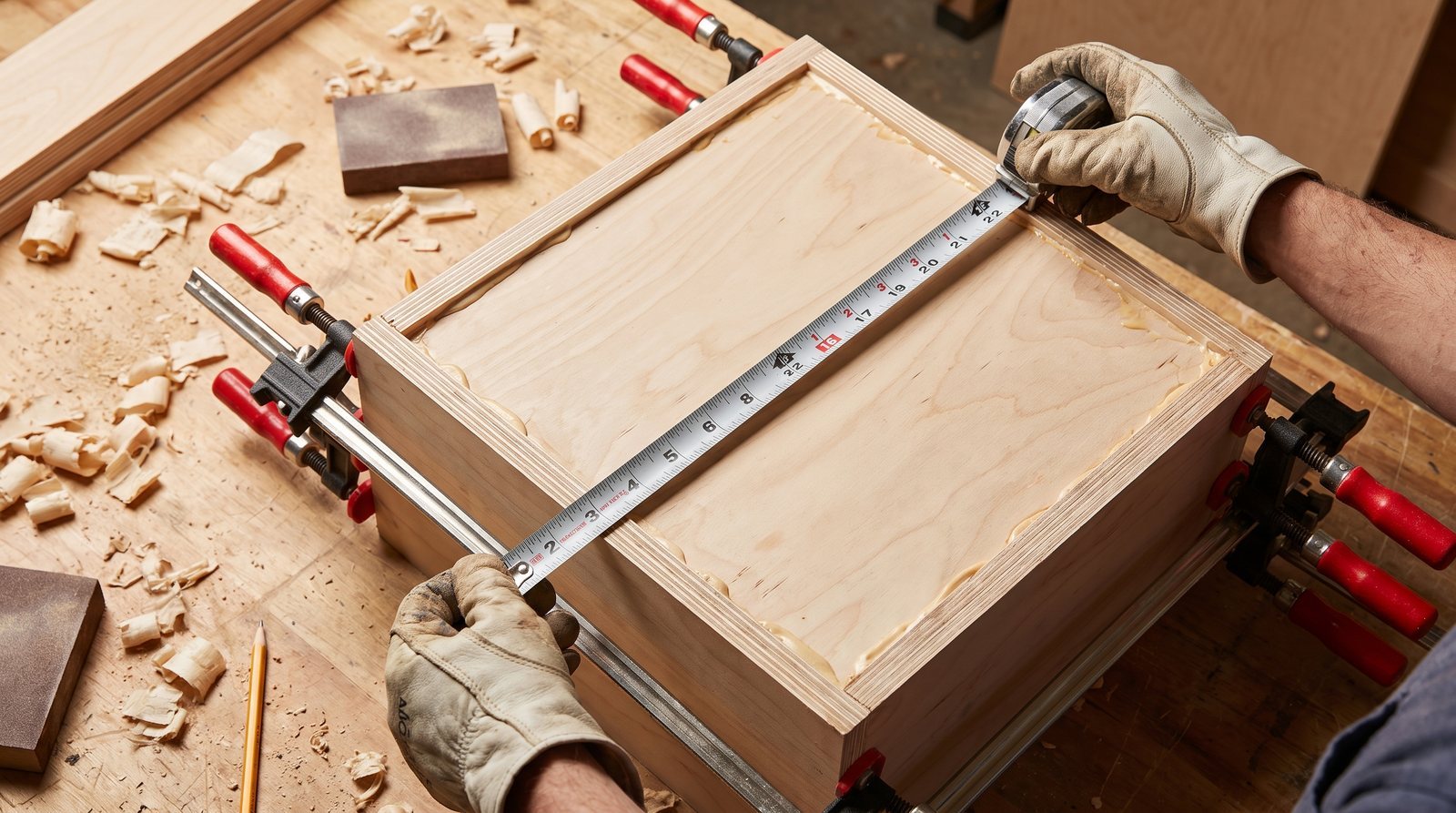
An out-of-square assembly is the single most common reason a beginner's cabinet doors won't close, drawers bind, or a picture frame looks "off" even though every cut was perfect. The good news: checking for square takes about 30 seconds once you know the technique, and fixing it usually means one gentle push before the glue sets. This guide covers three methods, from the simplest tape-measure check to the 3-4-5 triangle for large builds, so you can pick the right one for whatever you're clamping up.
Why squareness fails at the clamp-up
Most people assume squareness is a cutting problem. It isn't, usually. You can have four perfectly cut pieces and still end up with a parallelogram the moment you tighten your clamps, because clamp pressure doesn't always push straight inward. One jaw grips a hair higher than the other, or the clamp head is slightly angled, and the whole frame racks.
The other classic cause: opposite sides that aren't exactly the same length. Even a 1/16" difference between the two rails of a face frame is enough to throw the diagonals off. Before you reach for a single clamp, dry-fit your pieces on a flat surface and confirm that parallel parts match. Stack them on top of each other if you have to. This five-second habit prevents most squareness headaches.
Method 1: Diagonal measurements
This is the go-to check for any rectangular assembly, from a 6" picture frame to a 30" cabinet box.
The idea is simple. A true rectangle has two diagonals of equal length. Measure corner to corner one way, then corner to corner the other way. If the numbers match, you're square.
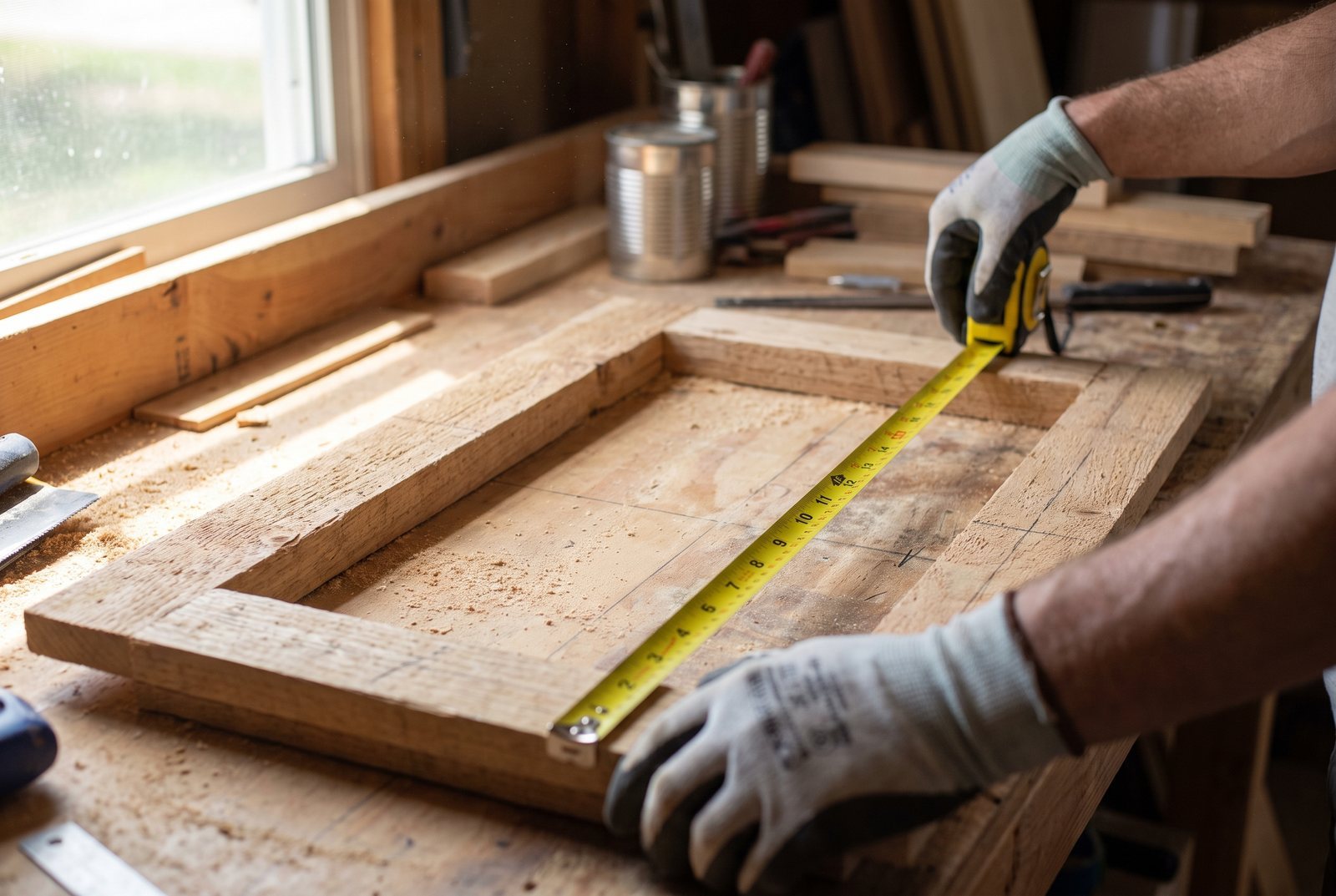
Here's where beginners trip up:
Inconsistent measurement points. You need to hook or touch the exact same spot on each corner. Outside-to-outside is easiest with a tape measure. If you measure one diagonal from the outer edge and the other from the inner edge, your numbers will never agree.
Tape sag on long runs. On anything over about 4 feet, a drooping tape reads long. Keep it taut, or better yet, have a helper hold the far end.
A bent tape hook. That little metal tab is supposed to slide back and forth by exactly its own thickness. If it's been dropped or stepped on, it can introduce 1/16" of error or more. Check it against a known straight edge before you trust a close reading.
For a typical cabinet (say 24" x 30"), a difference of 1/32" to 1/16" between diagonals is acceptable and won't show. On a large deck frame, aim for within 1/8" across the full span.
Fixing a racked frame. If one diagonal reads longer, push gently on the two corners of that longer diagonal. You're collapsing the parallelogram back into a rectangle. Recheck, adjust, repeat. Do this before the glue grabs, which on standard wood glue gives you roughly 5 to 10 minutes of open time.
One important caveat: equal diagonals only prove squareness if the opposite sides are truly the same length. A shape called an isosceles trapezoid can have equal diagonals without any 90-degree corners. That's why confirming matching side lengths first matters so much.
Method 2: Corner clamping jigs
If you'd rather prevent racking than diagnose it, corner clamps hold two pieces at 90 degrees while you fasten them. They're especially handy when you're working alone and don't have a third hand to hold the joint while you drive a screw or pin.
There are a few styles worth knowing about:
| Type | Best for | Typical price (Oct 2026) |
|---|---|---|
| Single-screw corner clamp (e.g., Pittsburgh 3 in.) | Light frames, picture frames | Around $5 each |
| Dual-screw corner clamp (e.g., Bessey WS-3+2K) | Mixed-thickness stock, precise work | $40 to $50 each |
| Positioning/clamping squares (e.g., Rockler Clamp-It) | Cabinet boxes, plywood carcasses | $28 to $41 for jig + square |
| Band/strap clamp (e.g., Bessey strap clamp) | Multi-sided frames, mitered picture frames | $20 to $30 |
A budget-friendly starting point is a 4-pack of 90-degree corner clamps like the WETOLS set (around $24 on Amazon). They let you clamp all four corners at once, which is the real trick: if you only clamp one or two corners, the unclamped corners can still shift.
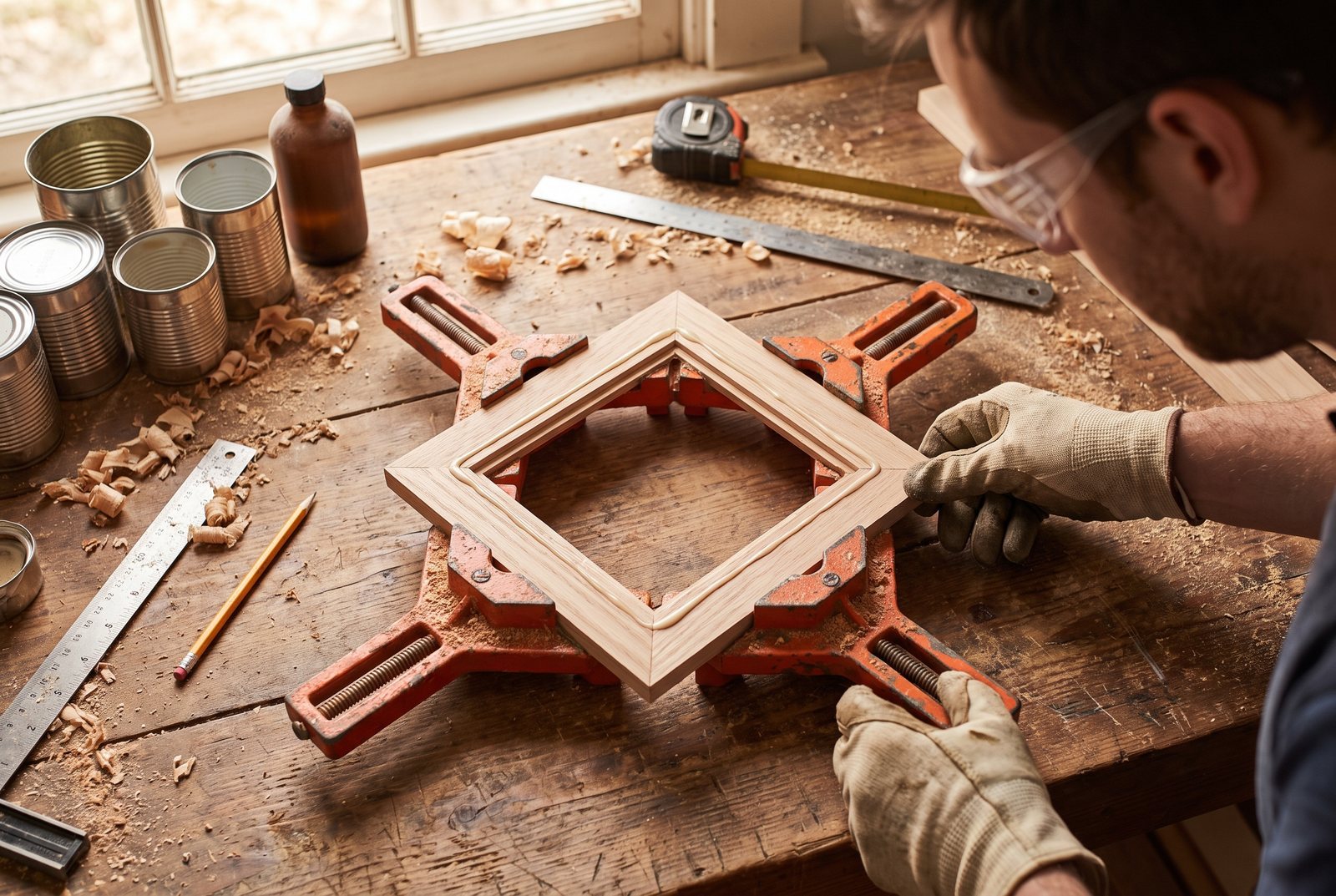
The over-tightening trap. This is the most common clamping mistake across the board. Cranking a clamp until your knuckles go white crushes wood fibers, starves the joint of glue (you squeeze it all out), and can bow thin stock. Tighten until the joint is snug and you see a thin, even bead of glue along the seam. That's enough.
Protect the surface. Metal clamp jaws leave dents. Keep a pile of small scrap-wood offcuts near your bench and slip one between the jaw and your workpiece every time.
Even with corner clamps on every joint, measure your diagonals before the glue sets. Corner clamps are a positioning aid, not a guarantee. A clamp that's slightly out of calibration or a piece that's not perfectly flat can still introduce a small error.
Indy Farm Life's Simple Plywood Garage Cabinet is a good example of a straightforward box assembly where checking diagonals during glue-up keeps the whole build on track. The project uses 3/4" plywood and basic tools, and it's the kind of build where getting the carcass square at the start means everything else (shelves, doors) fits without fuss.
Method 3: The 3-4-5 triangle for larger assemblies
A framing square is accurate, but it's only 16" x 24". On a shed floor, a large bookcase, or a deck frame, that's too small to catch errors that show up over several feet. The 3-4-5 triangle scales to any size.
It works because of the Pythagorean theorem: if one side of a triangle is 3 units, the adjacent side is 4 units, and the hypotenuse is exactly 5 units, the angle between the 3 and 4 sides is precisely 90 degrees.
Here's how to use it:
- From the corner you want to check, measure 3 feet along one edge and make a fine pencil mark.
- From the same corner, measure 4 feet along the other edge and mark it.
- Measure the distance between those two marks. If it's exactly 5 feet, the corner is square. Less than 5 feet means the angle is under 90 degrees; more than 5 feet means it's over.
For better accuracy on bigger projects, scale up: use 6-8-10, 9-12-15, or even 12-16-20. A larger triangle reduces the effect of a small marking error.
The limitation. The 3-4-5 method checks one corner at a time. A rectangle has four corners, and squaring just one doesn't guarantee the whole thing is square (you could still have a parallelogram). Check at least two opposite corners, then confirm with a full diagonal measurement across the assembly. Think of 3-4-5 as the rough adjustment and diagonals as the final verification.
Putting it all together: a clamping sequence
Safety first: Always wear safety glasses when clamping, as parts can slip under pressure. For a typical cabinet box or rectangular frame, this order works well:
- Before assembly: Confirm opposite sides are the same length. Check your tape hook.
- Dry-fit the pieces on a known-flat surface (a sheet of MDF on sawhorses works). Check diagonals.
- Apply glue and clamp. Start with light pressure on all corners before fully tightening any single clamp.
- Measure diagonals immediately. Adjust by pushing the long diagonal's corners or shifting clamp angles.
- Tighten clamps to final pressure (snug, not crushing). Recheck diagonals one more time.
- Let it sit on the flat surface until the glue cures. Don't move it to a sagging shelf or lean it against a wall while wet.
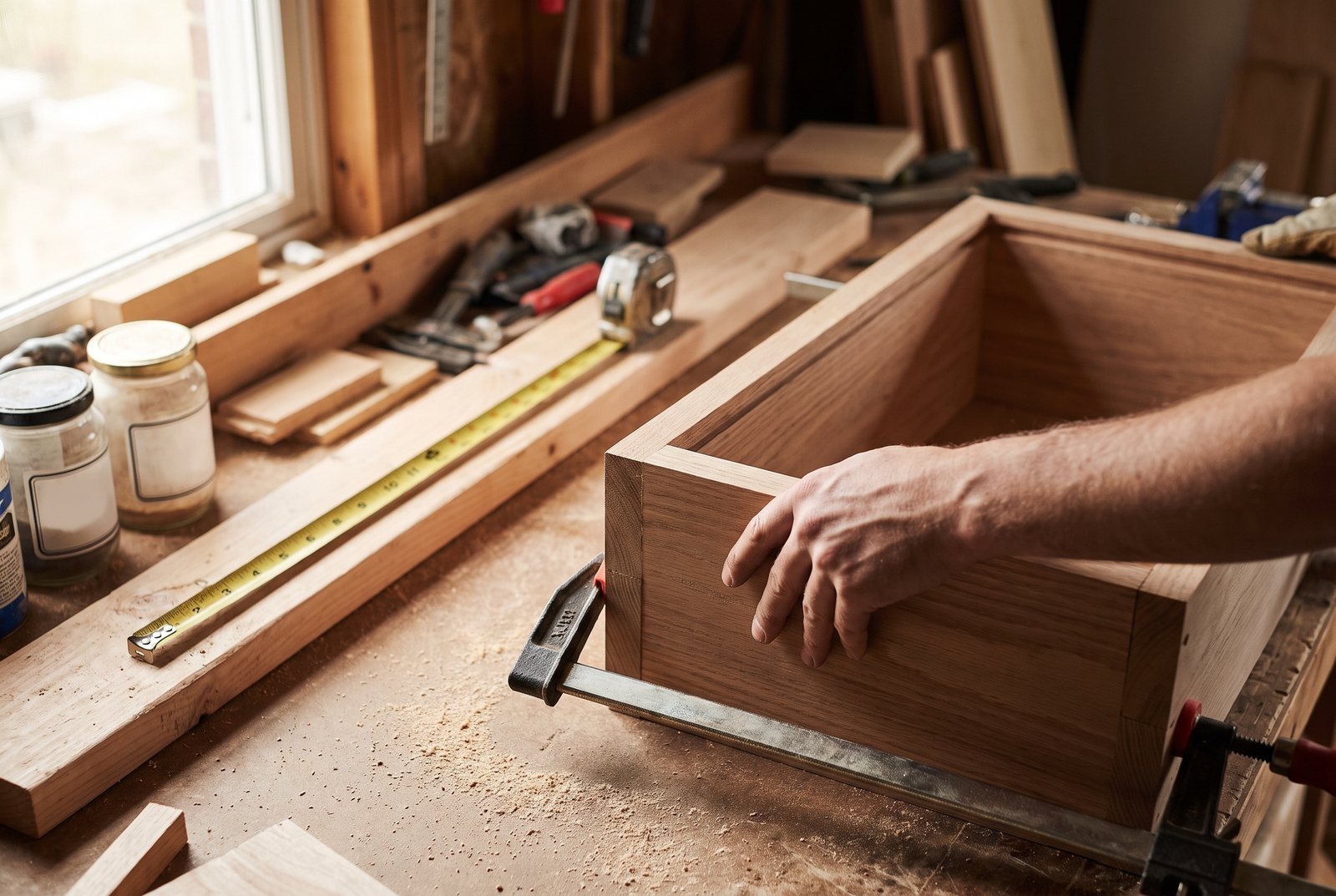
The whole check-and-adjust cycle adds maybe two minutes to a glue-up. Compared to the hours you'd spend trying to fix a racked cabinet after the glue has dried, it's the best two minutes you'll spend on any build.
When "close enough" really is close enough
Perfection is for machined parts. Wood moves, expands, and contracts with humidity. For furniture and cabinets, 1/32" to 1/16" difference in diagonals is fine. You won't see it, and seasonal wood movement will exceed that anyway. For a deck or shed frame, within 1/8" across the full span is the target. If you're consistently hitting those numbers, your builds will look and function like they should.
Quick answers
How do I check if a frame is square with a tape measure?
Measure both diagonals, corner to corner. If the two measurements are equal, the frame is square. Make sure you measure from the same point (outside to outside) on each corner, and confirm that opposite sides are the same length before you trust the result.
Do I need corner clamps to get a square assembly?
No. Corner clamps are helpful, especially if you work alone, but you can get a square result with regular bar clamps and the diagonal measurement method. The key is clamping all corners (or at least two opposite ones) and checking diagonals before the glue sets.
How accurate is the 3-4-5 triangle method?
It's very accurate for squaring individual corners on large assemblies where a framing square is too small. For best results, scale up to 6-8-10 or larger, and always follow up with a full diagonal check across the entire rectangle to confirm the whole assembly is square.
What's the acceptable tolerance for squareness on a cabinet?
For a typical cabinet (around 24" x 30"), a diagonal difference of 1/32" to 1/16" is acceptable. That margin won't affect how doors hang or drawers slide, and normal wood movement will exceed it over the seasons.
The project in this post
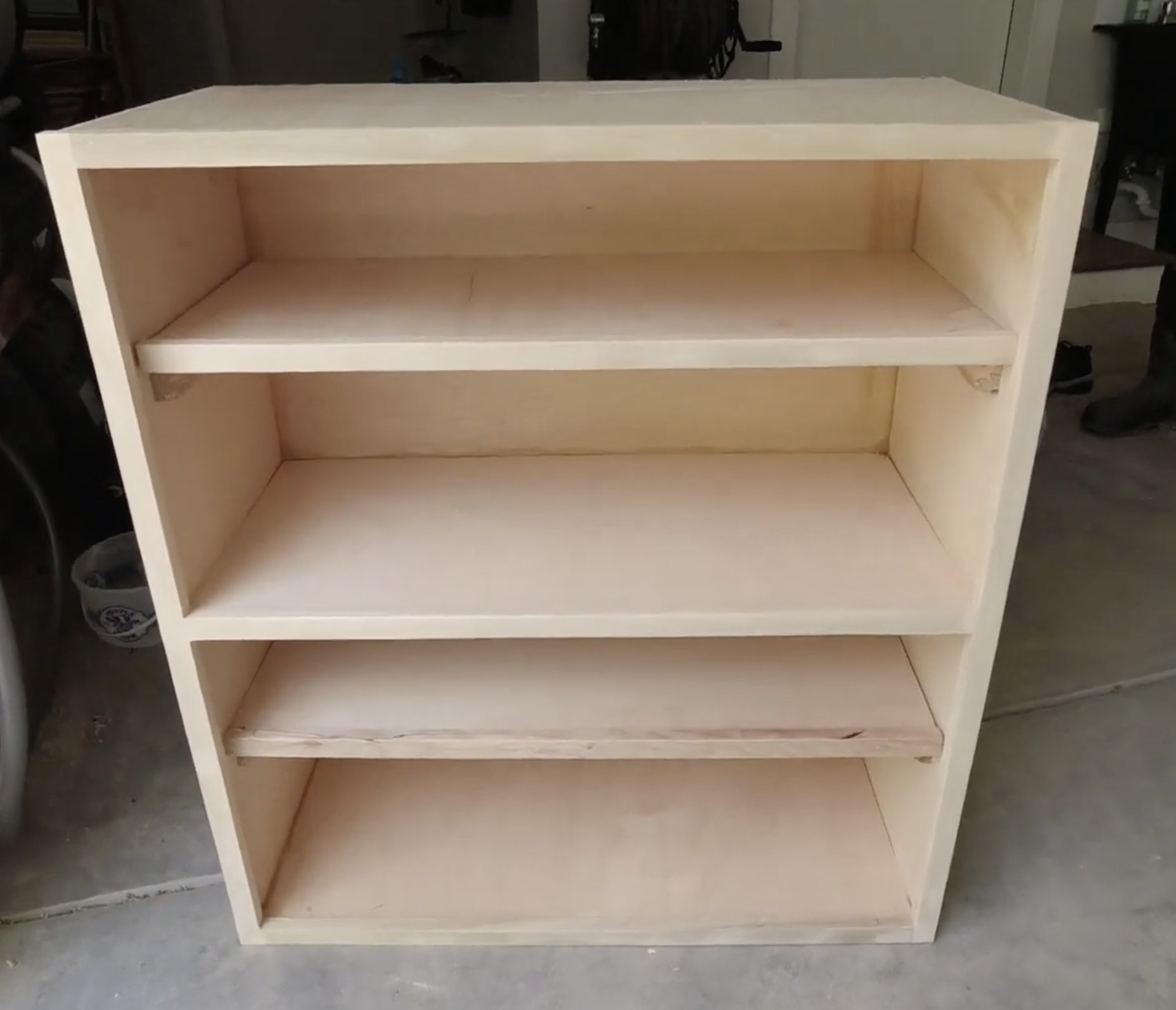
Simple Plywood Garage Cabinet
by Indy Farm Life
Open the project guideKeep reading
All posts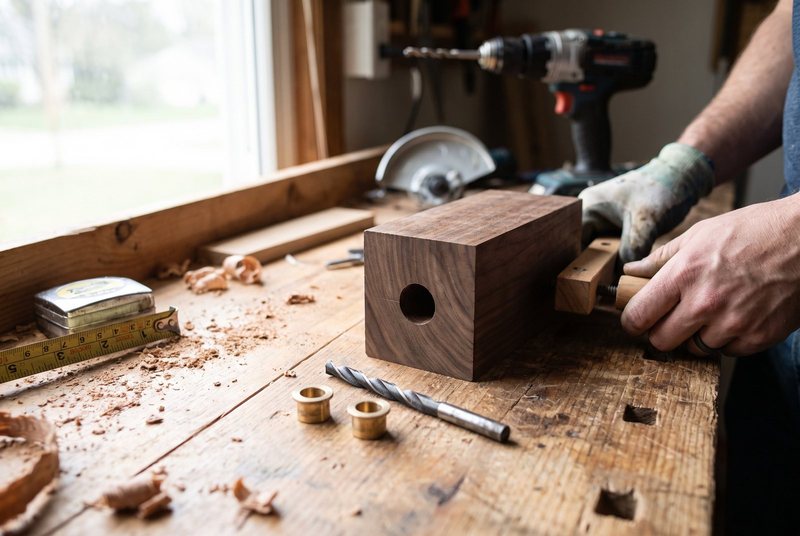
How to Drill Straight Holes Without a Drill Press
Three proven methods for drilling perpendicular holes by hand: a shop-made guide block, the square-and-mirror trick, and portable drill guide attachments.
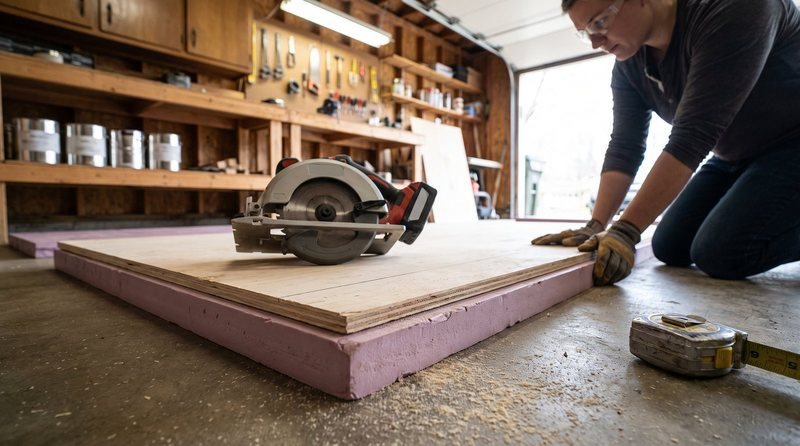
How to Support Plywood for Solo Cutting Without a Table Saw
Three setups for cutting a full 4x8 plywood sheet alone: foam board on the ground, 2x4 rails on sawhorses, and a cutting grid with dimensions and costs.
How to Build a Plywood Garage Cabinet with a Circular Saw
A simple 3/4" plywood garage cabinet built with a circular saw and brad nailer. Covers plywood choice, cost, assembly, and tips for beginners.